Vst Plugin Custom Folder
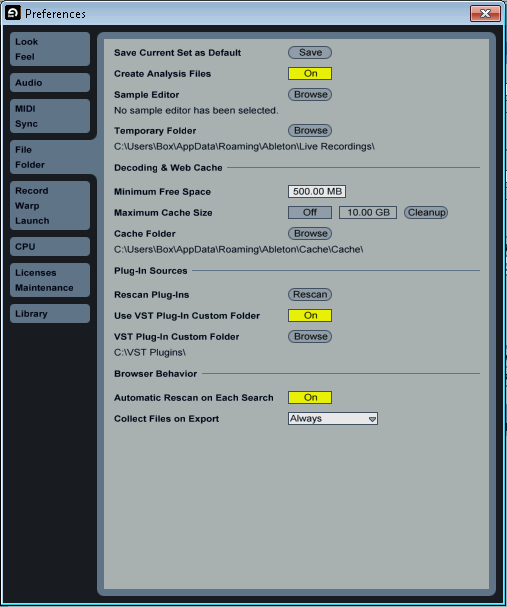
I am wondering if I can set up a custom folder for my VST plugins. Is there a config.cfg file that I can edit, to set one up? I have reviewed this page. Make sure 'Use VST Plug-In Custom Folder' is set to 'On.' Click the Browse button to the right of 'VST Plug-In Custom Folder.' Choose your 32-bit VST Plugin folder. Click 'Rescan' if necessary, to scan your folder and find your VST plugins. What To Do If A Plugin Doesn't Appear In Live. Under 'Preferences', select the 'File Folder' menu. Click the 'Browse' button next to 'VST Plug-In Custom Folder'. Select the folder you would like Ableton to use for VST Plug-Ins. Confirm that the 'Use VST Plug-In Custom Folder' option is turned on, and the file path listed under 'VST Plug-In Custom Folder' leads to the folder you just selected. Activate the button Use VST Plug-In Custom Folder. Note: If it is the first time you activate this button and no VST Plug-in custom folder has previously been defined, Ableton will immediately ask you to browse for your VST Plug-in folder, as explained below in point 4. Click the Browse button next to VST Plug-in Custom Folder. Unless you have installed your VST plug-ins to a custom folder, the standard installation path can be in one of many locations on Windows. If you can’t seem to find a plug-in or virtual instrument VST within your DAW, the first thing to do is check the folder locations below and see if the. Vst3 file is there. Go to Preferences File Folder and click on the ‘Browse’ button for “ VST Plug-in Folder”, and browse and select “Ableton VSTs. Live will scan all VST folders you have placed shortcuts to in the “Ableton VSTs” folder. Now, when you click on “Plug-ins”, you will notice the shortcut names as folders.
Note: we recommend to use only one folder for all your 32 bit VST files and another for your 64 bit VST files. Open the Live Preferences and go to the Plug-Ins ('File Folder' on older Live versions) tab. Activate the button Use VST Plug-In Custom Folder.
Unlike other DAWs (FL Studio at least, which is what I use), Ableton Live allows you to choose only one custom VST plugin folder. This drives a lot of people nuts, especially when moving from another DAW to Ableton.
Fortunately, there is an easy solution- shortcuts! Here’s how to easily point to many VST folders from Live:
- Choose a folder or create one that you will to point to from Live later on. This doesn’t need to contain any plugins. Let it be an empty folder if you please. Let’s call it “Ableton VSTs” for this article.
- Now here’s the important step- create shortcuts of all your VST folders that you want tracked by Live and drop those shortcuts in “Ableton VSTs”. Rename these shortcuts to meaningful names (you’ll find out why ahead).
- Go to Preferences> File Folder and click on the ‘Browse’ button for “VST Plug-in Folder”, and browse and select “Ableton VSTs.
Live will scan all VST folders you have placed shortcuts to in the “Ableton VSTs” folder. Now, when you click on “Plug-ins”, you will notice the shortcut names as folders. Enjoy!
As shown some time ago for the Mac, today’s tip shows you how to organize your plug-ins on windows, in order to find and load them quickly into Blue Cat’s PatchWork or MB-7 Mixer.
As you will see, It’s no rocket science, and this will greatly improve your experience and reduce the time to load your plug-ins.
Spending Too Much Time Looking For Plug-Ins?
Some people have been asking for the capability to load the plug-ins directly from the menu instead of having to open an Explorer Window. While this may be added in the future to our software, be aware that it may never beat what you can already do today with the Windows Explorer or Finder, as you will see below…
Ableton Vst Plugin Custom Folder
How To
On Windows, whatever you do, your VST plug-ins folder will probably quickly look like a huge mess, unfortunately…
The Vst Plugin Custom Folder Could Not Be Found Ableton
There is however a very simple way to overcome this issue and organize your plug-ins properly: it will just take you a few minutes!
To quickly access your plug-ins, without modifying the original install locations (for optimal compatibility), just do the following:
1. Create a new folder somewhere convenient on your system. For example in the ” My Documents” directory.
2. Label the new folder as “Plug-ins”.
3. Drag it into your Sidebar Favorites section to make it available as a shortcut there.
4. Go to your VST plug-ins folder.
5. Right click on each plugin you want and choose “Create shortcut” (multi-selection works too).
6. Move these shortcuts to your new folder, and create sub-folders to organize them.
Vst Plugin Custom Folder
Here you go! You can now access plug-ins quickly using the shortcuts, inside the appropriate folders:
Best free desser vst. VST Plug-Ins organized into subfolders, directly accessible from the Favorites Sidebar
Additional Tip: You can also choose to add several folders to the favorite bar instead of a single one, to access directly the mostly used plug-ins that you use most of the time.
One More Tip: It is possible to add a shortcut to the same plug-in in different folders, as it may be valid for several categories.
Not Fancy Enough? Add Some Icons!
Once you have properly organized the plug-ins thanks to shortcuts and linked to them from the favorites bar, you may want to add some colors to it and change the icons. You can set a different icon for each folder, and even for each plug-in:
Plug-Ins Folders with Custom Icons
With custom icons, it is even easier to find the plug-ins: a glance will suffice to pickup the right one!
Free Search Included!
And one more thing… Did you know that you can then use the standard windows search feature to find the plug-ins? Just type in a name and you’ll get it instantly!
VST Plug-In Search Included !
Conclusion
Simply using the Windows Explorer properly and taking the time to organize things will greatly improve the plug-in loading experience. There are even features that are not available in most host applications (how many do provide custom icons and search?).
Do you still need an included plug-in menu? Please discuss below!